Rope Action City Fighting Game
- 4.4
- Rating
- 10.00M
- Installs
- Free
- Price
 Analysis by App-foxy
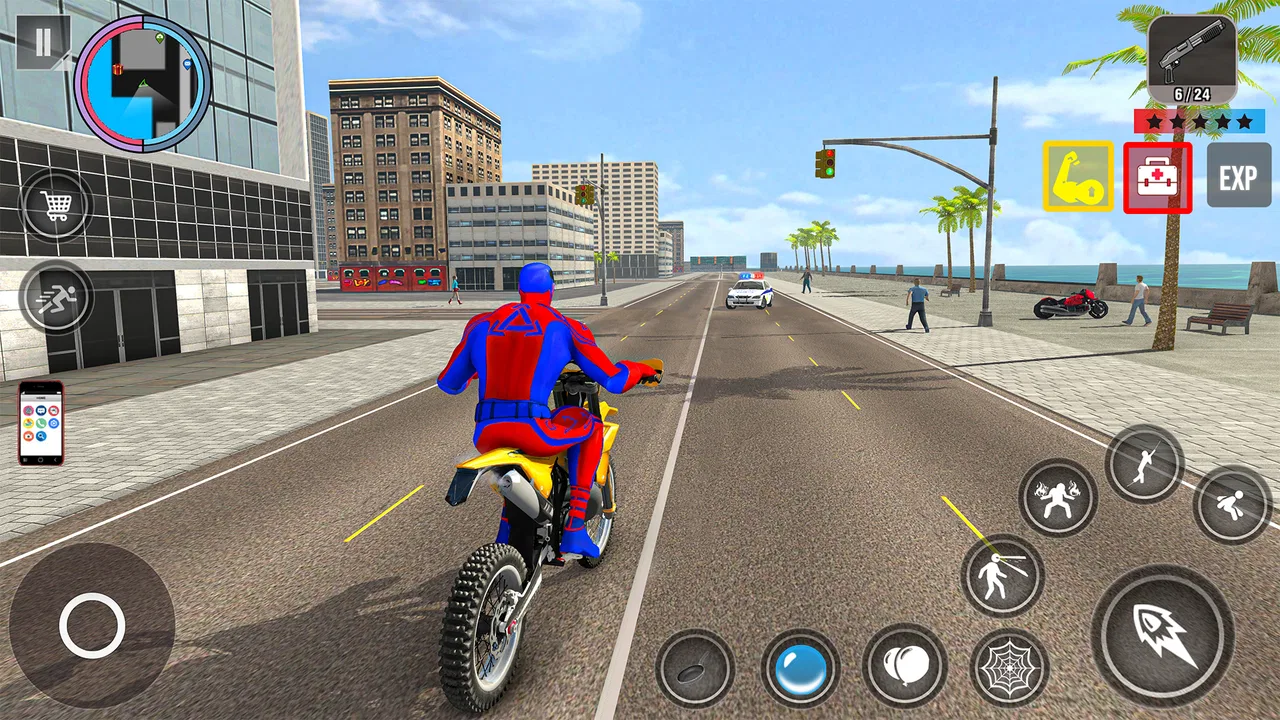
Rope Action City Fighting Game is the kind of mobile role-playing game I open when I want immediate movement rather than a long conversation tree or a slow tactical battle. Its central idea is simple: I can swing through a city with a rope, get into fights, take control of vehicles, and use that freedom to push through a hero-style adventure. That mobility is the feature that gives the game its identity. It changes the city from a background into something I actively travel through, escape across, and use to approach trouble.
After spending time with it, my view is that this is best treated as a quick, action-led open-world experience rather than a deep role-playing epic. The appeal comes from the feeling of grabbing a route across the streets, switching between movement and combat, and deciding whether to go directly toward an objective or make the trip more entertaining. It is free to play, made by HitBox Games, and aimed at Teen players. The current version is 9.5, while the game runs on Android 7.0 or later.
Why the rope movement matters more than the fighting
The rope is not just a decorative superhero trick. In practice, it is the game’s main answer to the problem that affects many mobile open-world games: getting from one activity to another can feel like a chore. Here, travelling itself can become part of the play. I can move above street level, change direction quickly, and approach an area with more control than I would have if I were simply following roads.
You May Also Like

 Blood Strike: 2.5 Anniversary
Blood Strike’s Loadouts Turn Every Drop Into a Tactical Gamble
A close look at Blood Strike’s custom loadouts: how fast access to signature weapons reshapes its battle royale rhythm, rewards preparation, and narrows the gap between fights.

 Pandora - Music & Podcasts
Pandora’s Music Is Easy to Start, but Harder to Recover
Pandora’s strength is its low-effort path from a seed to a station. Its weak spot is how much confidence it asks you to place in connection, setup, and quiet recovery.

 8 Ball Pool
 Is Built on Rivalries, Rematches, and Routine
A close look at the rivalries, rematches, shared routines, and unanswered safety questions that turn a quick pool match into a persistent mobile community.

 Samsung Music
’s Quiet Strength Is Playing What You Already Own
Its reach comes less from spectacle than from dependable access to a personal library. That simplicity is both the app’s strongest retention engine and its ceiling.

 AccuWeather: Weather Radar
AccuWeather Review: A Quick, Clear Forecast for Everyday Decisions
For everyday plans, the best forecast is the one you can understand quickly. AccuWeather makes rain timing, radar, and local conditions easy to act on, with a few trade-offs.

 Hill Climb Racing
Why Hill Climb Racing Still Turns Crashes Into One More Run
A tiny car, a bumpy hill and one more upgrade: Hill Climb Racing keeps resurfacing because its simple chaos makes every near-miss feel personal.
More From Our News Desk
View All News


That makes the game feel different from a conventional role-playing title built around menus, turn-based encounters, or a fixed sequence of battles. I am not only choosing attacks. I am also choosing how to enter a situation. A direct approach is usually the fastest, but swinging around the city creates room for experimentation. I can use height and distance to avoid an unnecessary confrontation, reposition before a fight, or simply take a more enjoyable route when I am not in a hurry.
The capability is especially useful because the game combines movement with vehicles. Driving gives me a grounded way to cross the city, while the rope gives me a more agile option when roads become inconvenient or when I want to move like a comic-book hero. The contrast between those two methods keeps the basic travel loop from feeling completely flat. Vehicles are practical; the rope is expressive.
The strongest part of Rope Action City Fighting Game is the freedom to decide how I reach the action. That choice has a bigger effect on the experience than the simple promise of an open city. In many games, an open map only means there is more space between missions. Here, the rope can make that space playable, provided I enjoy experimenting with movement instead of expecting a tightly directed campaign.
What swinging changes during ordinary play
When I first approach the game, the rope is easy to understand at a basic level: aim toward a surface or point, attach, and use the pull to gain speed or height. The important part is not mastering a complicated control scheme. It is learning to think ahead. A short swing can help me clear a street, while a better-placed attachment can carry me farther and make the next movement feel smoother.
I found that the ability rewards patience more than frantic tapping. If I repeatedly aim at whatever is closest, the character may move, but the route can become awkward. Looking slightly ahead and choosing a useful anchor produces a much better rhythm. This is one of the less obvious lessons of the game: the rope feels less like a button that launches the hero and more like a movement tool that works best when I plan the next connection before the current swing ends.
That planning also affects combat. Reaching a fight from the road and reaching it from above do not feel identical, even when the battle itself is straightforward. Aerial movement can give me a moment to observe the area, while a vehicle can provide a fast escape or a way to cover ground before I engage. I would not call the game a stealth title, but the ability to choose an approach gives the encounters more personality than a simple walk-and-punch routine.
For touch controls, I recommend using deliberate gestures and avoiding constant corrections. Small, rapid adjustments can make the hero lose the clean line of travel. I also found it helpful to separate movement decisions from attack decisions: first establish where I want to land, then focus on the fight. Trying to swing, steer, and attack without a clear priority is where the controls feel busiest.
Using movement as a practical shortcut
The rope is most valuable when I use it to reduce downtime. If I am crossing a familiar section of the city, I do not need to treat every street as a new destination. I can take a vehicle when the route is open, then switch to the rope when the road becomes less convenient. That combination is more useful than relying on either method all the time.
A good everyday pattern is to drive until I am close to the area I want, leave the vehicle when it starts to slow me down, and swing the final stretch. This avoids turning every trip into a long aerial sequence while still preserving the hero feeling. It also gives the two travel options distinct jobs instead of making one of them feel pointless.
Another useful habit is to use height for orientation. From the street, it can be easy to lose track of where I am going, especially when the city presents several possible directions. Gaining a little elevation gives me a better sense of the surrounding layout. I do not need to swing across the entire map every time; a short lift can be enough to reset my bearings and choose a cleaner route.
That is the kind of practical value a short store description cannot communicate. The rope is not automatically fun simply because it exists. It becomes fun when I use it to solve small travel problems: bypassing a crowded-looking route, recovering from a wrong turn, reaching a destination without following every bend, or creating distance when a fight becomes inconvenient.
How a typical session feels in practice
A normal session can begin with a simple intention: explore, fight, travel, or use vehicles for a while. I like that the game supports short bursts because the basic controls are quick to pick up. I can spend a few minutes moving around and testing the city without needing to commit to a long role-playing session. That makes it a reasonable choice for a phone when I want action immediately.
The experience is less satisfying if I expect every activity to have the depth of a dedicated fighting game or a large console open-world adventure. The combat is there to support the hero fantasy, not to replace a specialist brawler. Likewise, the role-playing label describes the broader adventure structure, but players looking for intricate character builds, elaborate dialogue, or highly detailed progression may find the focus too light.
My preferred way to play is to alternate between purposeful movement and small diversions. I might start by driving toward an area, switch to rope travel for the final approach, handle a fight, and then spend a little time testing whether I can leave the area more efficiently than I entered it. This gives the session a natural beginning, middle, and end without requiring me to treat the map like a checklist.
The game’s open-world design also means that self-direction matters. If I need constant instructions and tightly staged objectives, some of the freedom may feel like a lack of focus. On the other hand, if I enjoy making my own small goals, the movement system fills in some of the space between formal activities. I can practice routes, compare driving with swinging, or simply look for a more satisfying way to cross a familiar part of town.
A realistic use case for short mobile sessions
Imagine I have a short break and want something more active than a puzzle but less demanding than a long story game. I can launch the game, choose a nearby destination, and make the trip using a vehicle and the rope instead of waiting through a complicated setup. If I have enough time, I can add a fight or explore a side route. If the break ends, the session still feels complete because the movement itself provided a clear activity.
This is where the game makes the most sense to me. It is not asking me to remember a large cast of characters or manage a complicated inventory before I can enjoy it. I can focus on the physical pleasure of moving through the city and the quick satisfaction of an encounter. That accessibility is valuable for casual players who like superhero-style action but do not want a demanding simulation.
For younger players, the Teen content rating is worth taking seriously. The combination of fighting, vehicle action, and an urban hero setting is not designed as a quiet children’s game. Parents should also remember that the game is free to download but includes in-app purchases priced from $2.99 to $19.99 per item. I would approach those purchases carefully and decide in advance whether the free experience is enough for the intended player.
Where the open city works, and where it feels thin
The city works best as a playground for movement. Streets, open areas, and vertical routes give the rope a reason to exist, and vehicles provide another way to interact with the space. The environment becomes more interesting when I stop treating it as scenery and start asking practical questions: Can I reach that area faster from above? Is driving better here? Should I land before beginning the fight?
It feels less compelling when I expect every part of the map to contain a memorable discovery. The game’s main strength is the way I move through the city, not the promise that every corner will deliver a complex story or a carefully authored event. That distinction matters. Players who enjoy traversal and quick action will probably forgive a simpler world structure. Players who explore mainly to uncover rich narrative details may want a more story-focused alternative.
The rating from players sits at a 4.2 average, with over 18 thousand ratings, and the game has passed 10 million installs. Those figures suggest that the straightforward hero formula has found a broad audience, but they do not change my practical advice: install it for the rope-driven movement and casual open-world action, not because you expect a full-scale role-playing system.
The trade-offs behind the freedom
The biggest trade-off is control versus precision. The rope makes travel exciting, but touch-based swinging can feel less exact than movement in a dedicated platform game. When I want to reach a particular point, the result depends on the angle, the available surface, and how quickly I adjust. That unpredictability can create entertaining recoveries, but it can also frustrate me when I am trying to arrive neatly.
There is also a trade-off between speed and spectacle. A direct route is often more efficient, while a longer sequence of swings is more enjoyable to watch and perform. I do not always want to optimize. Sometimes I play for the sensation of moving like a hero, even when driving would be quicker. The game works best when I accept that not every choice has to be the fastest one.
Combat creates a similar compromise. The action keeps the session lively, but players who want highly technical fighting mechanics may find the battles less rewarding than the traversal. I see combat as a reason to use the movement system, not as the sole reason to keep playing. If I remove the rope and vehicles from the experience, much of the game’s personality disappears.
Free access is another practical advantage with a financial consideration attached. I can try the core experience without paying at the start, which makes it easy to decide whether the movement feels right for me. However, the presence of item purchases means I would not hand the device to a child without considering purchase controls. The game’s free entry is convenient, but it does not mean every optional part of the experience has no cost.
Device compatibility is relatively approachable because Android 7.0 is the minimum operating system requirement. Still, compatibility alone does not guarantee that every phone will feel equally comfortable. A larger screen can make aiming and steering easier, while a smaller display may make precise rope placement more demanding. I would also prefer playing with a steady grip, since the game asks for frequent touch input during movement.
When another type of game is a better choice
I would choose a dedicated fighting game instead if my main goal were deep combos, strict timing, and competitive mastery. I would choose a traditional role-playing game if I wanted elaborate character development, party management, and a story that carries the entire experience. I would also look elsewhere for a calmer exploration game with little or no combat.
Rope Action City Fighting Game is a better fit when I want the overlap between those categories: recognizable hero movement, quick battles, vehicles, and an open environment that I can cross in different ways. It does not need to win every category. Its value comes from combining them into short, accessible bursts.
One trade-off I appreciate is that the game lets me create my own challenge without requiring a formal difficulty system. I can try to take a more direct route, avoid unnecessary detours, or practice a clean swing from one point to another. That is not the same as a deep challenge mode, but it gives experienced players a reason to improve their handling rather than simply repeating the same actions.
Who gets the most from this hero adventure
I would recommend it to players who enjoy movement-first games and want a city that can be crossed by road or by rope. It is particularly suitable for someone who likes superhero fantasies but prefers quick, uncomplicated sessions. The game also suits players who enjoy experimenting with routes, because the most satisfying moments often come from deciding how to reach an objective rather than merely completing it.
It is less suitable for someone who dislikes touch-control uncertainty or wants every mission to feel carefully directed. Players who become bored when an open world leaves room for self-made goals may also struggle to connect with it. The same applies to anyone looking for a serious role-playing system with extensive customization and a story-heavy structure.
For a new player, I suggest spending the first session learning movement instead of rushing from fight to fight. Try short rope connections, then longer swings, and notice how much easier travel becomes when the next anchor point is chosen early. After that, compare a vehicle route with a rope route across the same area. This simple experiment reveals the game’s central trade-off faster than any description can.
I would also avoid treating every encounter as a mandatory stop. The freedom is more enjoyable when I use it selectively. Drive when I want reliable progress, swing when I want speed or style, and fight when the encounter adds something to the session. That approach keeps the city from becoming a repetitive sequence of identical actions.
HitBox Games has built a free role-playing game around a clear and accessible hook rather than an overloaded feature list. The result is uneven in the way many compact open-world mobile games are uneven, but the rope gives it a real point of difference. The game is at its best when movement, vehicles, and combat work together to create a small hero story that I control moment by moment.
My final recommendation is straightforward: try it if the idea of swinging through an urban playground sounds more appealing than managing a complex role-playing campaign. Approach it as a flexible action toy with adventure elements, not as a replacement for a deep console-style epic. With that expectation, Rope Action City Fighting Game can deliver enjoyable short sessions and a satisfying sense of freedom. If the rope movement does not engage you early, the simpler combat and open-world structure are unlikely to provide enough reason to stay.
FAQs for Rope Action City Fighting Game
01What is the main objective of Rope Action City Fighting Game?
In Rope Action City Fighting Game, the main objective is to take on the role of a hero with super rope abilities. Players navigate an open-world city, fighting against criminals and maintaining peace. The game combines action-packed combat with strategic missions, allowing players to upgrade skills and unlock new abilities.
02How do the controls work in Rope Action City Fighting Game?
The game features intuitive touch controls optimized for mobile devices. Players can swipe to maneuver their character, tap to attack, and use on-screen buttons to activate special abilities like swinging with ropes. A virtual joystick is also available for precise navigation, making it easy to master the gameplay quickly.
03Are there in-app purchases in Rope Action City Fighting Game?
Yes, Rope Action City Fighting Game offers in-app purchases. Players can buy various items such as new outfits, weapons, and skill upgrades. While the game can be enjoyed without spending real money, these purchases can enhance gameplay by providing additional customization and power-ups.
04Is Rope Action City Fighting Game suitable for all ages?
Rope Action City Fighting Game is designed for teens and older players due to its action-oriented content. While it features cartoon-style graphics, the themes of fighting and crime-solving, along with the use of weapons, make it more suitable for a mature audience. Parents should review content to decide if it's appropriate for younger children.
05Does Rope Action City Fighting Game require an internet connection?
No, Rope Action City Fighting Game does not require a constant internet connection. Players can enjoy most of the game features offline, making it perfect for on-the-go entertainment. However, some features like leaderboards or special events may require online access to function properly.
Pros
- Smooth and intuitive controls.
- Engaging and dynamic combat scenes.
- Wide variety of weapons available.
- Impressive graphics and animations.
- Offline play mode supported.
Cons
- Occasional in-app ad interruptions.
- Limited character customization options.
- Some levels feel repetitive.
- High battery consumption during play.
- Requires frequent updates for new content.

Rope Action City Fighting Game
Gallery